

In 2026, the dream of owning a home in Melbourne is facing a reality check. With traditional building costs skyrocketing and labour shortages delaying projects, many Victorians are turning to Modular Expandable Homes Melbourne as a smarter, faster, and more cost-effective investment solution.
Modular Expandable Homes Melbourne: Per Square Metre Breakdown (2025–2026)
Melbourne’s construction market has shifted significantly. As of early 2026, building a standard home in the Victorian capital can be costly, which is why many homeowners are choosing Modular Expandable Homes Melbourne for a faster, more predictable, and cost-effective solution.
Traditional Build Costs
For a standard brick-and-mortar or timber-frame home in Melbourne, you can expect to pay:
- Basic Build: $2,200 – $3,400 per m²
- Mid-Range Custom: $3,500 – $5,200 per m²
- High-End Luxury: $6,000+ per m²
Modular Expandable Costs
Modular homes, specifically expandable units like the Ownspace 20, offer a much more predictable and compressed price bracket:
- Average Modular: $2,500 – $3,000 per m²
- The Ownspace 20: Offers roughly 40m² of luxury living space at a fraction of the cost of a traditional custom 1-bedroom build.
Key Takeaway: While the cost per square metre can be similar on the surface, traditional builds often suffer from “bracket creep” where variations and on-site delays push the final cost 20–30% higher than the initial quote.
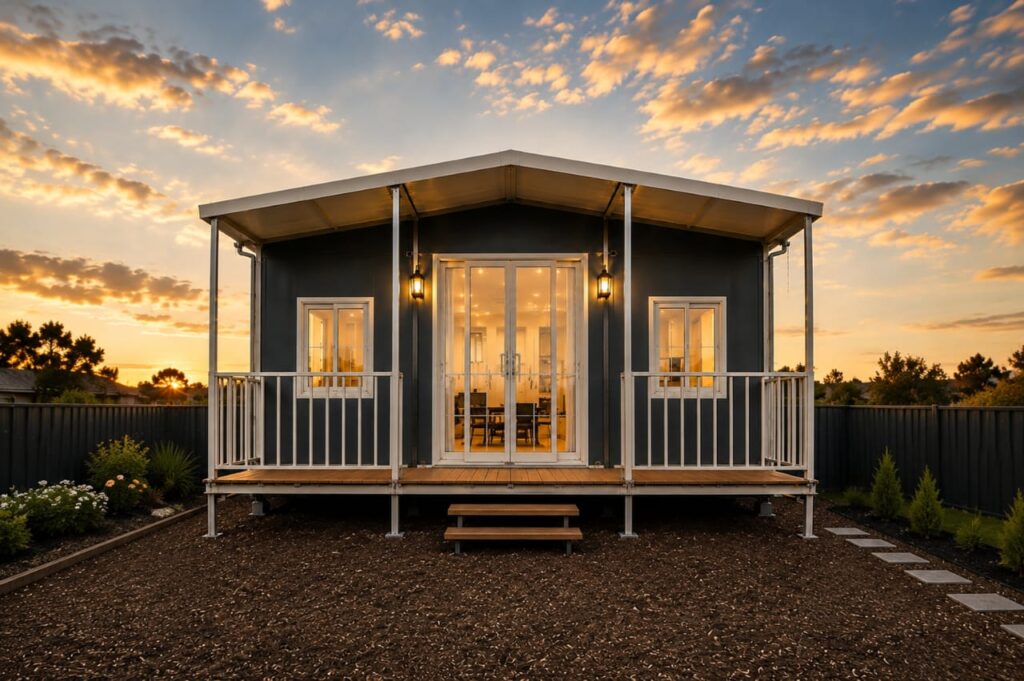
Modular Expandable Homes Melbourne: Speed as a Financial Asset & the “Holding Cost”
One of the most overlooked costs in Melbourne building is the holding cost. If you are building a traditional home, you are likely paying a mortgage or rent elsewhere for 12 to 18 months.
- Traditional Build: 12–18 months. (Paying $600/week in rent while waiting can add an extra $31,200 – $46,800 to your total build cost).
- Modular Build: 4–6 months. With Modular Expandable Homes Melbourne like the Ownspace 20, site preparation and home construction happen simultaneously in a factory setting. This significantly reduces the holding cost, saving nearly a year’s worth of rent or double-mortgage payments.
Modular Expandable Homes Melbourne: Hidden Costs – Inclusions vs Exclusions
Many Melbourne builders offer a “base price” that excludes the very things that make a house a home. When comparing a traditional build to Modular Expandable Homes Melbourne like the Ownspace 20, the difference in standard inclusions becomes clear:
| Feature | Traditional Melbourne Builder | Ownspace 20 (Containable Luxury) |
| Kitchen Benchtops | Often Laminate (Stone is an upgrade) | Natural Stone Standard |
| Glazing | Single Glazed (Double is an upgrade) | Double Glazing Standard |
| Climate Control | Extra Cost ($5k – $10k) | 2.5kw Reverse Cycle A/C Included |
| Security | Extra Cost ($3k – $5k) | 4-Camera CCTV System Included |
| Insulation | Minimum standard | High-spe |
In a traditional build, adding double glazing and stone benchtops to a small secondary dwelling can easily add $15,000 to your bill. With Modular Expandable Homes Melbourne like the Ownspace 20, these premium inclusions are part of the core luxury package, offering better value and cost certainty.
Site Works and Foundations
Melbourne’s soil varies wildly—from the reactive clays of the west to the sandy loams of the south.
- Traditional Foundations: Slab-on-ground construction in Melbourne can be expensive if the soil is “Class H” (highly reactive). Excavation, concrete, and labor costs for a small 40m² slab can range from $15,000 to $25,000.
- Modular Foundations: The Ownspace 20 is designed to sit on a series of concrete piers or a simple steel sub-floor. This requires significantly less concrete and excavation, often saving thousands on site-prep costs, especially on sloping blocks common in regional Victoria.
Resale Value and ROI
Historically, traditional homes held value better, but the tide is turning in 2026. The sustainability and energy efficiency of modular homes are now high-value selling points in the Melbourne market.
- The Airbnb Advantage: For those building a regional retreat, the faster “speed to market” of a modular home means you start generating rental income a year earlier than a traditional build.
- Asset Portability: Unlike a traditional home, if you ever sell your land but want to keep your house, a modular home can (in many cases) be folded back up and transported to a new location.
Final Verdict: Which is Cheaper?
For a 5-bedroom custom build in Toorak, traditional construction is the only path. For a luxury 1-bedroom home, granny flat, or regional retreat, Modular Expandable Homes Melbourne save $40,000 – $70,000 while including luxury finishes, reducing holding costs, and offering fixed-price certainty.